

Article: Muay Thai Gym Etiquette in Thailand: 10 Traditions & Unwritten Rules

Muay Thai Gym Etiquette in Thailand: 10 Traditions & Unwritten Rules
Muay Thai gyms in Thailand run on respect. Take your shoes off before the mat, greet your trainers with a wai, show up on time (late arrivals often do push-ups), never step over the ropes, and keep sparring light and playful. Follow these unwritten rules and you'll be welcomed at almost any camp, from Bangkok to Phuket.
Here's what to know before your first session in Thailand.
1. Shoes off before the mat (and the ring)
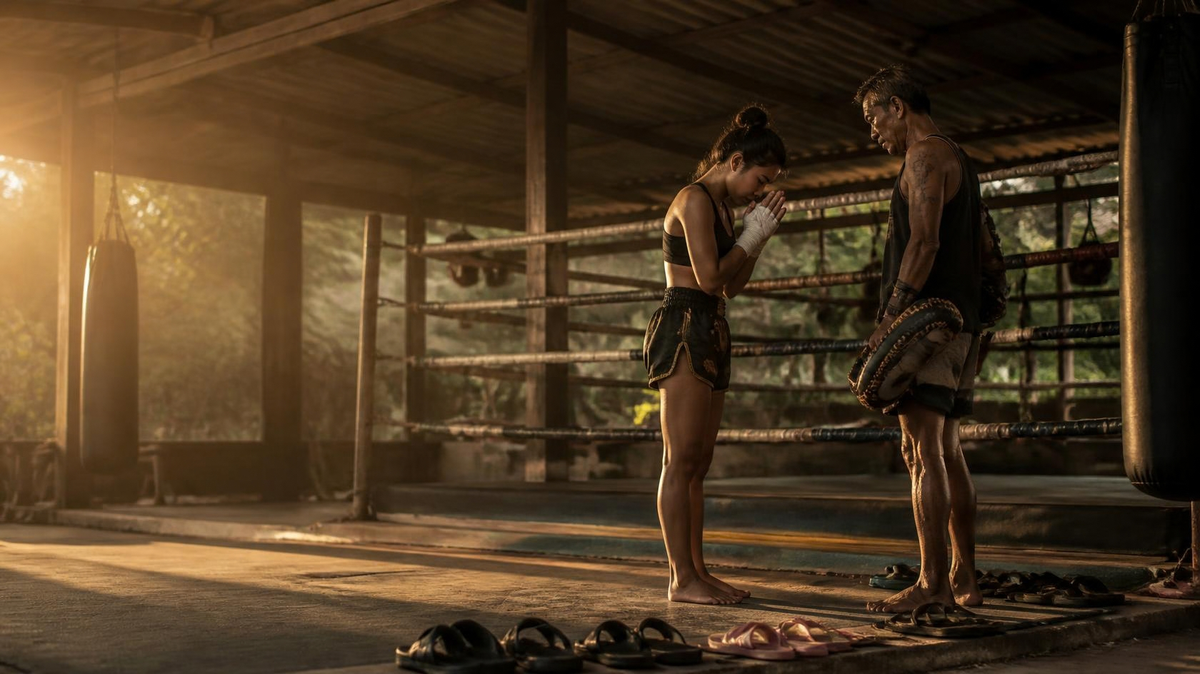
The training floor and ring are treated as respected spaces. Leave shoes, sandals and flip-flops at the edge. Many gyms also expect you not to walk barefoot from the toilet or street straight onto the mat, so keep a pair of slides handy.
2. Greet your trainers with a wai 🙏
The wai is a slight bow with palms pressed together at chest or chin height. Use it when you arrive, before and after pad rounds, and when you leave. A quick "sawasdee kha" (women say kha) goes a long way. Trainers (kru) are teachers, and showing respect is part of the art.
3. Late? Expect push-ups
Punctuality matters. At many camps, anyone who rolls in after the warm-up starts owes the group push-ups or burpees. It's lighthearted, but the message is clear: respect everyone's time.
4. Respect the rope
The ring is considered sacred in traditional Muay Thai and while gyms are almost always relaxed about using the ring, they are expensive to install and maintain, so you should respect it to help ensure its longevity. Don't sit on the ropes, pull at them or jump on them. Follow what your gym does.
5. Respect the mongkol and prajioud
The mongkol (headband) and prajioud (armbands) carry spiritual meaning. Never touch a fighter's mongkol, put it on the floor, or wear one as a costume. They are given by a kru, not bought as accessories.
6. Don't point your feet at people or step on equipment
Feet are considered the lowest part of the body. Avoid pointing them at trainers, and never step on equipment.
7. Sparring is playful, not a war
Thai sparring (len, meaning "play") is light, technical and full of laughter. Fighters tap, test and score, then smile. Coming in at 100% power is the fastest way to earn a bad reputation. Match your partner's pace and protect each other.
8. Their gym, their rules
Things may work differently in the gym back at home, but when training in Thailand, you are expected to follow the rules and routines of the gym you choose to train at. Don't try to change the way they teach or run their classes, and most especially don't ever try to bargain prices - they are a training facility, not a night market.
9. Look after your gear and the gym
Bring your own handwraps, wash them after every session, and wipe down shared pads or bags. Help put equipment away at the end of class.
10. Dress for heat and modesty
Thai gyms are hot and humid. Breathable women's Muay Thai shorts and a supportive crop top sports bra are standard for training. Outside the gym, cover shoulders and knees when visiting temples.
FAQ
Do I have to wai my Muay Thai trainer?
It isn't enforced, but it's expected courtesy in Thailand. Trainers notice and appreciate it, especially if the trainers are older.
Can women touch the ring in Thailand?
At some traditional stadiums women are not allowed in the main ring. Most training gyms welcome women in the ring for training. Follow your gym's rules.
Can I wear a mongkol if I'm not a fighter?
No. A mongkol is earned and given by a kru. Wearing one as fashion is seen as disrespectful.
How hard is sparring in Thai gyms?
Usually light and technical. The aim is to play and learn, not to hurt your partner.
What should I bring to a Muay Thai gym in Thailand?
Handwraps, Muay Thai shorts, a sports bra or top, a towel, a water bottle and slides. Most gyms lend gloves and shin guards, but your own are more hygienic.