


What Is the Wai Kru? The Meaning of the Muay Thai Pre-Fight Dance
The Wai Kru Ram Muay is the ritual dance a Muay Thai fighter performs in the ring before every fight. "Wai Kru" means paying respect to the teacher, and "Ram Muay" means boxing dance. In a few minutes, the fighter thanks her coach, her family and her gym, blesses the ring, and gets her mind ready to fight. It is one of the things that makes Muay Thai different from every other combat sport.

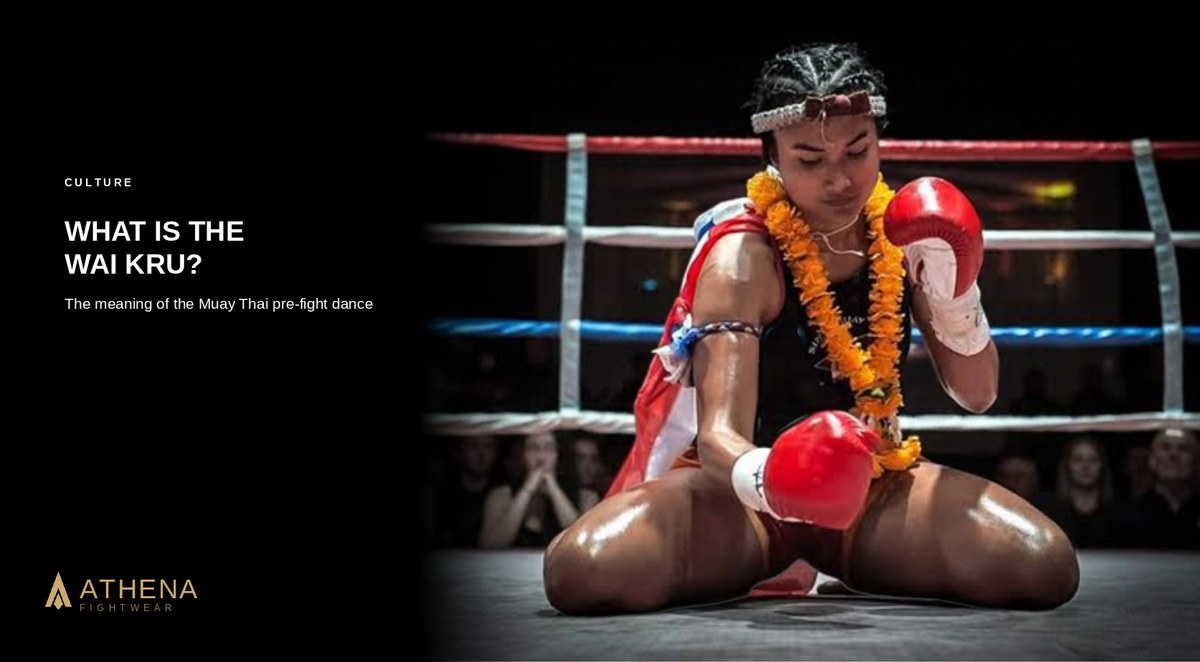
A female fighter kneels in prayer during her Wai Kru, wearing the Mongkon, Prajioud and a flower garland. Photo: W.L Fight Photography.
What does Wai Kru Ram Muay mean?
The name breaks down into four Thai words:
- Wai: the Thai greeting with palms pressed together, a sign of respect.
- Kru: teacher (from the Sanskrit word guru).
- Ram: dance, in the classical Thai style.
- Muay: boxing.
Put together, it is often translated as "the boxing dance that salutes the teacher". The Wai Kru is the act of respect. The Ram Muay is the dance that follows. Most people just say "the Wai Kru".
Where does the Wai Kru come from?
Muay Thai grew out of battlefield combat in old Siam, at a time when fighting and faith were closely linked. Warriors asked monks for blessings and protection before going into battle. Over the centuries, as Muay Thai became a sport, the ritual stayed. Its focus moved from the spirit world to the people who make a fighter: her teachers, her parents and her gym.
Many movements in the Ram Muay are linked to scenes from the Ramakien, the Thai version of the Ramayana. Hanuman, the monkey warrior, is a common inspiration. When fights were held in front of royalty, the Wai Kru also honoured the King.
Why is the Wai Kru so important?
- Respect. It thanks the Kru (coach), the gym and the fighter's parents. A sloppy Wai Kru is seen as an insult to the teacher.
- Spiritual protection. Fighters pray for safety for themselves and their opponent.
- Warm-up. The slow, deep stances loosen the hips, legs and shoulders and steady the breathing.
- Focus. It is a moving meditation. The crowd fades out and the fighter settles into the fight.
- Identity. Each camp has its own version, passed from Kru to student. Experienced fans can often tell which gym a fighter comes from just by watching.
- Reading the opponent. Traditionally, fighters also watched their opponent's dance to judge her balance, confidence and background.

A quiet moment before the fight. Photo: Pexels.
The Wai Kru step by step
Every gym does it a little differently, but most follow the same structure:
- Entering the ring. The fighter steps over the top rope, never under it. The head is considered the most sacred part of the body, and going over the rope keeps the blessed Mongkon above everything else.
- Sealing the ring. She walks the ring counter-clockwise, one hand running along the top rope, and stops at each corner to bow her head and say a short prayer. This marks the ring as protected space.
- The Wai Kru (kneeling bows). Kneeling in the centre of the ring, facing the direction of her home or her gym, she bows three times. The three bows honour the Buddha, the Dharma (his teaching) and the Sangha (the monks).
- The Ram Muay (the dance). She rises and performs her camp's dance: slow, graceful steps, deep lunges, high knee lifts and arm movements. Some include the "archer" (shooting an imaginary arrow) or the "hunter" pose, often turned towards each corner.
- Back to the corner. The fighter returns to her Kru, who says a final prayer and removes the Mongkon. The fight can begin.
A full traditional Wai Kru can last around five minutes. At many Western shows it is shortened to a minute or two.
The music: Sarama
The Wai Kru is performed to live music called Sarama (or Pi Muay). A small band plays the Pi Java (a reed oboe), Thai drums (Glong Khaek) and small cymbals (Ching). The music starts slow and gentle during the dance, then speeds up during the fight to match the action.
The Mongkon and Prajioud
Two sacred items are part of the ritual:
- Mongkon (Mongkol): the headband worn into the ring. It is blessed by monks or by the Kru, and only the coach should handle it. It must never touch the floor. The Kru removes it after the Wai Kru.
- Prajioud (Pra Jiad): armbands tied around the upper arm. They are also blessed, often contain a protective charm, and can be worn during the fight. In traditional Muay Thai they are not belts or grades; that ranking system is a Western addition.
Fighters often wear a flower garland (Puang Malai) as they walk out, a gift of good luck from friends and supporters.
Women and the Wai Kru
For a long time, women's Muay Thai was kept outside the main stadiums, and some traditional venues still have rules about how women enter the ring. That has changed fast. Women now fight on major cards in Thailand and around the world, and they perform the Wai Kru with the same respect and meaning as men. For many female fighters it is the proudest part of fight night: a moment to honour the coaches and family who backed them.
If you are training, ask your Kru to teach you your gym's Wai Kru. You do not need to be fighting to learn it, and many gyms practise it in class.

Fight prep starts long before the walk to the ring. Wearing Athena handwraps and Muay Thai shorts.
Wai Kru etiquette for spectators
- Do not boo or talk over the Wai Kru. It is a sacred ritual, not a pre-fight show.
- Do not touch a fighter's Mongkon.
- Be patient. A traditional Wai Kru takes time, and that is the point.
Gear up for fight night
From the walk to the ring to the final bell, the right kit helps you feel ready. Explore our women's Muay Thai shorts, cut for a female fit, and our Muay Thai handwraps for proper wrist and knuckle support. Building a full look? See our fighter outfits.
FAQ
What is the Wai Kru in Muay Thai?
The Wai Kru Ram Muay is the ritual a Muay Thai fighter performs in the ring before a fight. She seals the ring, bows to honour her teacher, family and faith, then performs a dance (the Ram Muay) unique to her gym.
Why do Muay Thai fighters dance before a fight?
To show respect to their Kru and gym, to pray for protection, to warm up and to focus. The dance is also a signature of the fighter's camp.
How long does the Wai Kru last?
A traditional Wai Kru can last up to about five minutes. Many shows outside Thailand ask for a shorter version of one to two minutes.
Do women perform the Wai Kru?
Yes. Female fighters perform the Wai Kru before their fights in Thailand and around the world, with the same meaning and respect as male fighters.
What is the headband worn during the Wai Kru?
It is the Mongkon (or Mongkol), a sacred headband blessed by monks or the fighter's Kru. Only the coach handles it, and it is removed before the fight starts.